
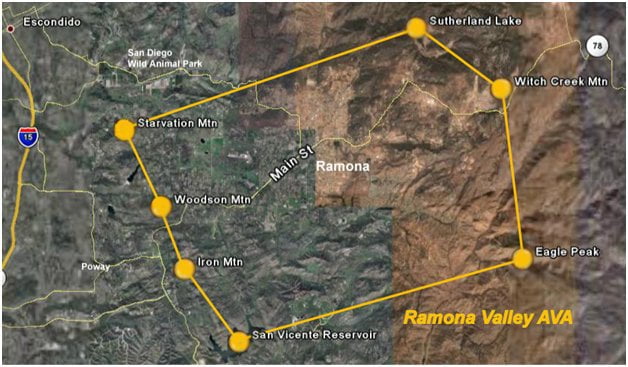
Nestled in the front range of the Pacific coastal mountains of Southern California, the Ramona Valley has a rich history of vineyards and winemaking, dating back to the early missions. Hot days and cool nights, influenced by the coastal marine layer and fog, contribute to conditions that produce quality wine grapes in the Ramona Valley. The area is a broad valley that is ringed by hills and mountains that isolate it from the surrounding areas. The valley has an average vineyard elevation of 1400 feet and an annual average rainfall of 16.5 inches.
Located approximately 35 miles NE of San Diego, the Ramona Valley American Viticultural Area was approved in January 2006 based on its unique microclimate, terroir, and history for grape production.
The following are excerpts from the January 6, 2006 press release:
The 89,000-acre area covers 139 square miles of primarily rural area surrounding the unincorporated town of Ramona, California, located in north central San Diego County. The area is home to more than 80 commercial vineyards covering over 100 acres, and 20 bonded wineries. New vineyards and wineries are being developed within the Ramona Valley each year.
American Viticulture Area designations, or “appellations,” were first created under federal law in 1980, and the Ramona Valley is the country’s 162nd area to be granted a designation. Ramona Valley is only the second AVA to be designated in San Diego County and the third in Southern California. It is within the large South Coast AVA which covers all of Southern California south of the Santa Barbara area.
The other two existing AVAs in the South Coast region are the San Pasqual Valley (San Diego County – designated in 1981) and Temecula Valley (Riverside County – designated in 1986).
The Ramona Terroir
We wonder a lot about the questions: What makes a great wine region? Why should one region expect to make great wine and other’s can hope to make adequate wine? What factors define the world’s best wine regions? And — Does Ramona have any of the right factors to aspire to the highest ranges of the lists?
Eventually it comes down to talented wine makers using wonderful grapes to create top-notch wine. Winemakers are not constrained by geography. They will eventually go where the grapes are, the concept of the ‘flying winemaker’ is not especially surprising.
So what does it take to make really good grapes? The grapes must reach the proper balance of ripeness, acidity, phenolic (flavor) composition and color compounds at precisely the same moment. Those regions of the world where the best grapes grow have many things in common.
Diurnal Shift
The difference of daytime heat to nighttime coolness is significant and consistent throughout the ripening season. Every wine region worth it’s claim to fame has this factor. Without it, it is almost impossible to get proper acidity into the wine without additives. Ramona is blessed with a terrific diurnal shift with our June-gloom marine layer giving way to desert heat almost every day during the summer. We’ve yet to see a Ramona harvest where ‘lack of acid’ has been a problem.
Soil
Looking at the great wine regions; some claim limestone; some claim volcanic; some claim shale; some claim granite. There has been a lot of recent research questioning the age-old belief that the soil “gets into the wine and gives it specific character”. Pinot seems to like limestone but some of the favorites don’t grow on limestone, many of them do. What you can see when you examine the regions: the soil is poor, the rocks are mineral rich and gravel is the predominant growing medium. Ramona is blessed with this wonderful, geologically new, decomposed granite that has just (practically yesterday) risen from the depths of the earth. We’ve got minerals and gravel in spades.
Climate Matched to Varietal
The climactic conditions vary the most from region to region. If any one thing determines which varieties will thrive in a region, it is the climate. From Winkler Index 1 (Rhine River, Oregon Coast) to Winkler Index 5 (Lodi, San Joachim, Sicily) the number of heat-hours influences what varieties thrive and what kind of yield targets are plausible. Ramona is blessed with several micro-climates, all of which mirror parts of the Southern Mediterranean sections of Europe. We have seen many varietals thrive here. We are seeing wineries specializing in Bordeaux, Rhone, Italian and Spanish varietals that have produced wonderful wines.
Altitude
Almost all of the great wine region of the world have significant altitude for their best sectors. (Bordeaux is clearly the exception.) Altitude allows air movement. Altitude enhances diurnal shift. Altitude usually means decomposing young mountains. Altitude provides sunshine which is more intense. Ramona is one of the highest altitude wine regions in the world. Five hundred meters above sea level is generally considered a limit. We extend quite a bit above that. Ramona’s altitude makes the “Valley of the Sun” more than just a Chamber of Commerce slogan. I think this is a big advantage for us.
Sunshine
The exposure to sunshine on a consistent basis allows the grapes to ripen regularly and surely. The difference between Chianti and Montalcino; between Burgundy and Beaujolais; between Cotes du Rhone and Languedoc is the sunshine available. The place where the grapes ripen consistently makes the best wine, year after year. Ramona has all the factors listed above: which put it in a climate class with Southern France, Spain or Tuscany; yet Ramona has the sunshine of Tunisia – seven hundred miles south of those regions. Again, it is hard to remember a harvest in Ramona where the grapes did not reach the sugar level targeted by the winemaker, with acids intact. When grapes reach 24.5 brix in Tuscany, that is considered a 5 star vintage and Reserve wines are expected. We achieve 24.5 brix on a regular basis.
Water
If everything else is perfect for a wine region they are at the mercy of the water delivery system. Water has to arrive in sufficient quantities to maintain vine growth, yet NEVER arrive when the fruit can be damaged. Mid-season sustained rain can be as disastrous as a drought for fine wine grapes. Very often a vintage can move from 5 star to nothing in a blink of a storm cloud. In Ramona we have the occasional summer thunderstorm (every couple of years) but rarely do we have an early winter storm that impacts the harvest schedule. And, in California, we are allowed to use irrigation systems (very efficient drip irrigation) whenever needed. Grapes require very little water, applied judiciously, so we can get it delivered when needed, on our schedule.
Ramona Gap
The Ramona Gap is a geographical feature in San Diego County, California that offers a way for the cool Pacific Ocean breezes to flow from the coast up into and across the Ramona Valley. These cooling breezes contribute to the important diurnal shift, cooling the grapes down each evening during in the growing season, which occurs from April to October. These wines also help eliminate moisture, preventing mildew, allowing for longer hang-time, which promotes more complex flavors in the ripening process.
So, piece of cake, right? Nothing could be easier than making Ramona a famous wine region. True, nature has supplied us with all the conditions FOR WHICH WE HAVE NO CONTROL. So no; it will not be easy. We just have the opportunity to do something special. We still have to do it: one vine, one bunch of grapes and one bottle of wine at a time.
